Church Award 2025
The ceremony took place in Pasym.
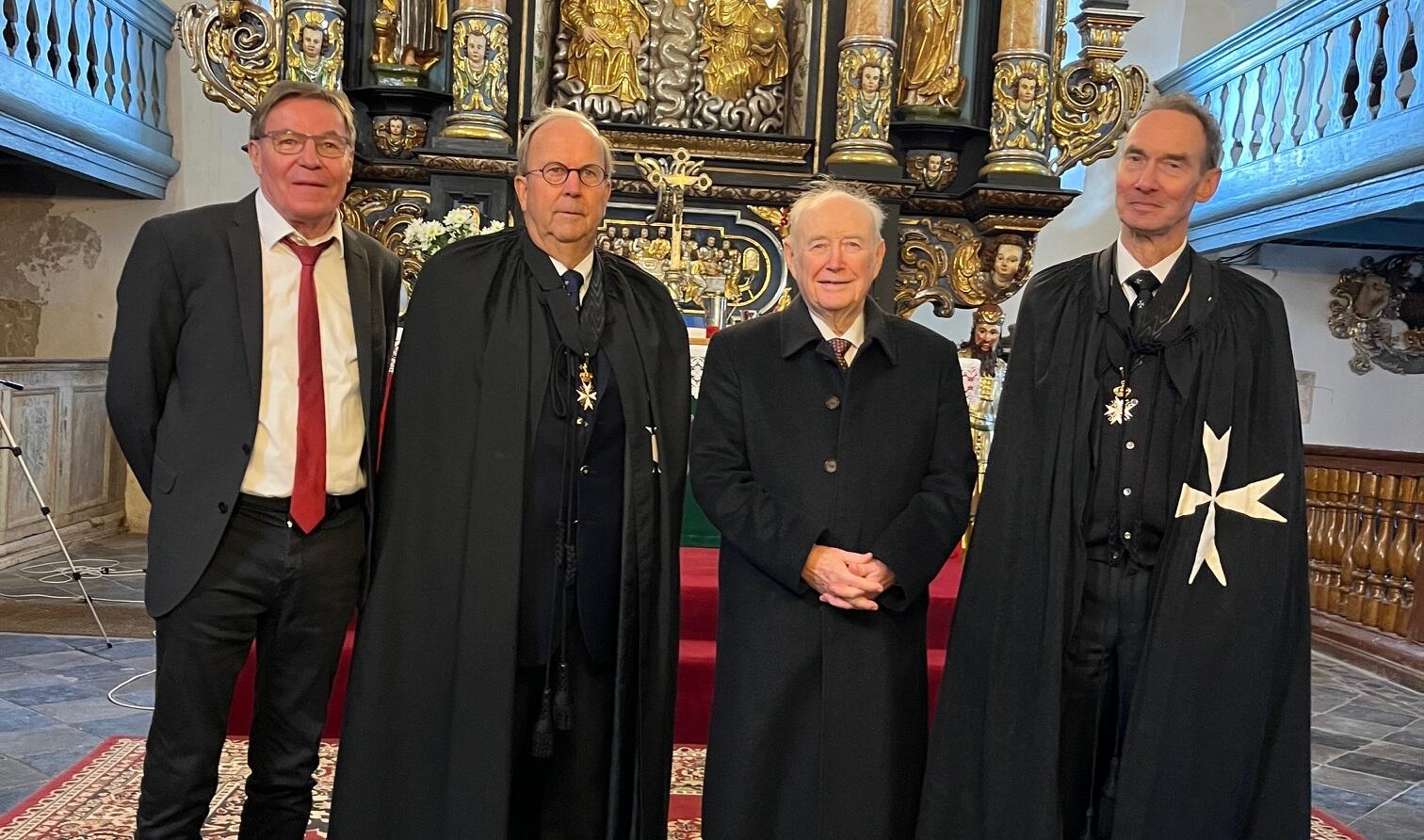
On 19 October, at the Evangelical‑Augsburg Church in Pasym, the ceremony of presenting the Princess-Anna-Vasa Church Award was held.
The award is given to individuals and organizations from Poland and abroad who have rendered outstanding service to the Evangelical Church of the Augsburg in Poland. It is presented annually around Reformation Day. The aim of the award is to honor persons or other entities who, by dedicating their time, skills, and resources, have borne witness to their faith and have worked or continue to work for the Evangelical Church of the Augsburg in Poland, guided by Christian love that knows no borders, as well as to promote and inspire efforts that establish and deepen international cooperation.
This year’s honorees were Rev. Burckhardt Hoelscher, the Brandenburg Bailiwick of the Order of St. John of Jerusalem, known as the Order of St. John (Johanniterorden), and Rev. Helmut Weiß. The ceremony was hosted by Anna Wrzesińska, Coordinator for International Relations. The awards were presented by the Presiding Bishop of the Church, Jerzy Samiec, and the President of the Synod, Rev. Dr Adam Malina.
The laudation for Rev. Burckhardt Hoelscher was read by Rev. Dr Adam Malina. Rev. Hoelscher was recognized for many years of work for reconciliation and bridge‑building between nations, Churches, and generations. A Lutheran pastor from Westphalia, for decades nurtured partnerships between German and Polish parishes, in particular the cooperation between Iserlohn‑Letmathe and Jawor. He initiated numerous projects, concerts, and youth encounters that combined spiritual, social, and cultural dimensions. His work exemplifies an evangelical understanding of the ministry of reconciliation—active, open, and rooted in the Gospel. He devoted special attention to fostering a living memory of history, including the legacy of Dietrich Bonhoeffer. Through lectures, publications, and artistic initiatives, Rev. Hoelscher highlighted the contemporary relevance of Bonhoeffer’s message in the pursuit of peace and the strengthening of faith. Despite retirement, Rev. Burckhardt Hoelscher remains active in church life: he preaches, builds links with partners in Poland, and his engagement continues to bear fruit in new projects.
In his remarks after receiving the statuette, Rev. Hoelscher referred to Ephesians 2:14 (“He is our peace!”), to his father’s story, and to the experience of faith that led him to work for reconciliation. Rev. Hoelscher’s father, sent to the Eastern Front during the Second World War, was taken prisoner by the Russians and experienced the horrors of war, returning home only in 1948. Despite the trauma, he kept faith in Christ’s forgiveness. He spoke openly with his children about the crimes of the German Nazis and showed them the small New Testament he had carried, where the words from Ephesians 2:14 were marked in red. He told, among other things, how in the camp he and a Roman Catholic fellow prisoner celebrated the Lord’s Supper together under extremely difficult conditions. They read the words of institution—“Given for you!” “Do this in remembrance of me!”—and then broke between them the small piece of bread that was their daily ration and shared the sip of water they had. A Lutheran and a Catholic united by God’s Word, a sip of water, and a piece of bread: the Lord’s Supper— in captivity, and yet in freedom! As an adult, Rev. Hoelscher understood this as a call to evangelical freedom—the “freedom of a Christian” about which Martin Luther wrote. A freedom that obliges Lutheran Churches to work together for reconciliation and to assume responsibility for the problems facing contemporary societies. In his speech, Rev. Hoelscher recalled Polish‑German partnership initiatives and emphasized the role of the Churches in building historical memory and education in the spirit of forgiveness, pointing to the importance of Christian reconciliation both locally and across Europe. He spoke of Christians’ responsibility for truth and memory, and of the need for courage in acknowledging shared guilt and shared hope.
The laudation for the Order of St. John was read by Bishop Paweł Hause. The justification highlighted more than three decades of the Order’s presence in Poland and its exceptionally consistent diaconal assistance—both in the Masurian and Wrocław dioceses and in many local parishes. The Order was honored for its charitable and humanitarian work, organizing social and nursing aid stations, supplying medical equipment, and supporting education and social work in rural regions.
The award on behalf of the Order was received by Alexander Baron von Korff, Lieutenant of the Order of St. John and a member of the Order’s Chapter, representing the Master of the Order, Prince Oskar von Preussen, and by Alexander von Negenborn, Commander of the Prussian Commandery of the Order. In his speech, Alexander Baron von Korff thanked the Church for the award and emphasized the importance of the Order’s long‑standing cooperation with the Evangelical‑Augsburg Church in Poland. He also highlighted the wide range of educational, diaconal, and social activities carried out in the spirit of Christian mercy. He assured the continued readiness of the Order to act “shoulder to shoulder” with partners in Poland and of the trust they place in Lutheran parishes in our country.
The laudation for Rev. Helmut Weiß was read by Bishop Professor Adrian Korczago. Rev. Weiß was honored for his many years of service in the development of pastoral ministry, pastoral psychology, and supervision within the Lutheran community in Poland, as well as for his contribution to building international theological cooperation. He co‑created the pastoral training system, initiated Polish‑German seminars and conferences, and financially supported the participation of Poles in international events, enabling their active involvement and co‑creation of global pastoral discourse. He played a key role in establishing the Polish Association for Pastoral Counseling and Psychology and in the training and education of Polish pastoral supervisors. As the author and editor of numerous scholarly publications, including textbooks and conference proceedings, he helped disseminate knowledge and good pastoral practice. His academic, teaching, and pastoral work stands as an example of faithful, competent service to the Church and to people, and his personality combines humility, consistency, and a deep understanding of the role of dialogue.
In his speech, Rev. Weiß expressed gratitude for the award and recalled that he had met many wonderful people in Poland, and that working with them was a great joy. He led pastoral courses mainly in southern Poland and in Warsaw and considers this a privilege and an important part of his work. He emphasized that the essence of pastoral care is listening—attentively listening to another person, their experience, and their emotions. Only then can a genuine, helpful relationship be formed—and this, he said, is the language of the Church. He referred to one of the conferences on ministry within the resistance movement in the Nazi era, calling such ministry prophetic because it requires courage, fidelity to conscience, and adherence to professed values. He said that Princess Anna Vasa, whom he admires for her independence and strong convictions, was like a prophetess, faithful to what she believed.
In conclusion, he referred to a meeting with Bishop Pavlo Shvarts and Rev. Alexander Gross of the German Evangelical Lutheran Church of Ukraine, who—despite the war and immense hardships—remain with their community. For Rev. Weiß, this is a contemporary example of prophetic pastoral ministry.
The event was attended by representatives of the Church Synod, pastors of the Masurian Diocese, representatives of Lutheran parishes in Poland that cooperate with the honorees, guests from Germany, and parishioners from Pasym.
The ceremony was enriched by music prepared by organist Dr Maciej Zakrzewski and the “Pasjonata” Choir under the direction of Joanna Gawryszewska.
The event was held under the patronage of the German Embassy.